Novels between collapse and eternity
Stories that remain when tomorrow does not.
Matthias-Johannes Fischer writes about worlds at the edge of ending—and lives that may never end.



Novels between collapse and eternity
Matthias-Johannes Fischer writes about worlds at the edge of ending—and lives that may never end.
The work
From a sinking Hamburg to a superyacht in the Pacific – eight books that reach out to one another without resembling one another.
The author

Matthias-Johannes Fischer writes novels that resist simple categories. Sometimes he lets his home city disappear into the fog of war; sometimes he follows a human being who never dies – and in both cases the same question is at stake: What remains of us when everything familiar no longer holds?
With Kein Morgen mehr, he imagines a dystopian Hamburg grappling with the aftermath of a wartime attack that had previously seemed unimaginable. This is not a military thought experiment, but a story about people who want to survive – and about whether there can still be a tomorrow after catastrophe.
The novel Living Forever I, published in German and English, tells the chronicles of “Patient Faust” – a man facing eternity long before he understands what it means for him. To understand his own situation, he retreats into the role of a modern Faust, loses his “Greta” amid the turmoil of research, and makes a wager on eternal life with the future expert “M”. When he realizes that the boundaries of space and time are losing their reliability for him, his memories and visions – preserved as chronicles – lead him through the past and into one possible future.
Living Forever II – Patient Faust continues the story. The patient’s awakened self becomes a contested oracle as he struggles over the reality of his memories and ultimately over the copying of his consciousness. At the same time, the second volume casts the chronicles of the first novel in a new light: what initially appears to be memories, visions and digressions becomes understandable as the attempts at exploration and survival of a human being whose thinking is inseparably linked to artificial intelligence.
A third volume, Living Forever III – Das Ende der Ewigkeit, is in preparation for 2027.
Also scheduled for 2027 is the literary financial thriller Geld ist ein Messer, which Fischer began in 2023. It brings the characters of Brecht’s The Threepenny Opera onto a modern stage: Macheath, “Mack the Knife”, becomes the Ferrari-driving accountant of the dubious financial company “Chicago Central Trust”, while the ruthless patriarch Peach directs its business. Against the Chicago skyline, a story emerges about money, dependency and the question of how much morality a system can tolerate when it acts solely in its own interest.
The novel Verschlossenes Herz tells of a young love in Dresden. At its center are two stories of flight separated by generations, and a guilt kept secret for decades even in the shadow of a narrative of victimhood.
Das Tor zur Hölle opens a window onto an almost forgotten story. Twelve kilometers beneath the earth, science ends – and a legend begins. In 1983, East German scientist Anke Vogel and her husband Jost are sent to the Soviet superdeep drilling project on the Kola Peninsula. While Jost works at the technical limits of the project, Anke receives a secret assignment. Years later, a tape recording surfaces. It allegedly contains the screams of people from deep underground. In the autumn of 1989, East Germany’s State Security forces Anke to remember Kola: a devastating drilling accident, a vanished geophysicist, Western intelligence services – and the question of what was actually recorded there. Because sometimes what matters is not whether a story is true. But whether the world is ready to believe it.
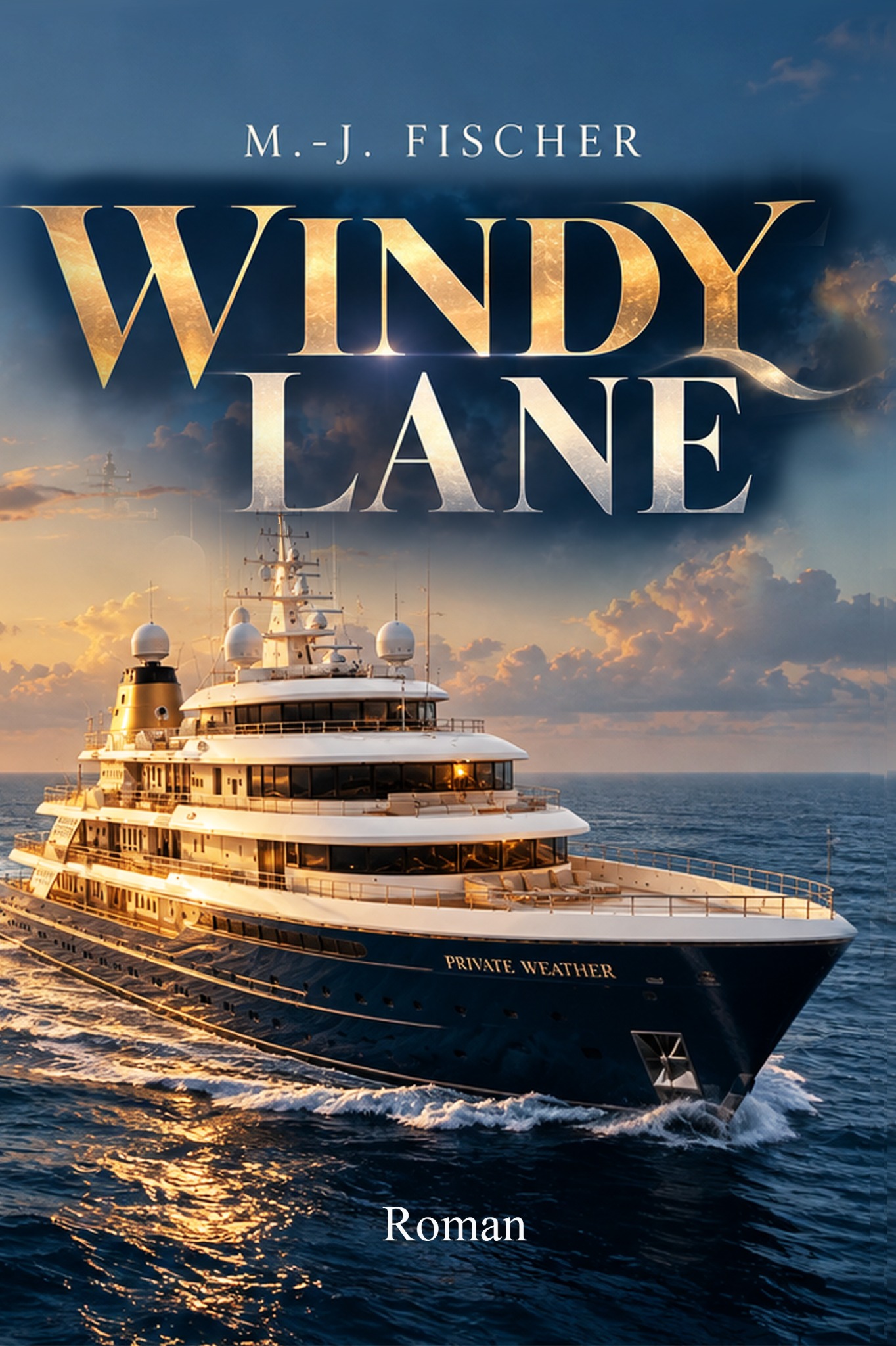
Windy Lane – Die Weltformel is a novel about artificial intelligence, power and the boundary between calculation and control. For four weeks, billionaire Alden wants to retreat to his superyacht Private Weather. Just sea, wind and distance from everyday life. Alden has made the world more predictable: his artificial intelligence CIVITAS connects climate, economics, resources and human behavior into a system that recognizes relationships before others even see them. But off the coast of California, something begins to slip out of balance. Messages reach the ship, old certainties lose their validity, and as the weather intensifies, a question arises that Alden has long suppressed: What happens when a system that understands ever more clearly how the world works begins to draw its own conclusions from that understanding?
“Until recently, we still believed we were standing at the end of all questions, yet our age is now losing its old answers at record speed,” Fischer says of the connection between his novels. “We are heading toward a fundamental upheaval that could put historical turning points in the shade. Literature, for me, is therefore not a business. Writing has once again acquired an existential purpose.”
Fischer lives and writes in Germany, near Düsseldorf. His novels are published in German, with individual works also available in English; stories and companion texts are available in several languages and free of charge. The books are available through Amazon and bookstores.
Contact
Questions about the books, readings, reviews or rights may be sent by email.