What philosophical science fiction can do
Philosophical science fiction does more than predict possible technologies. It asks how technical possibilities change our ideas of personhood, freedom, love, guilt and mortality. The central subject is therefore not the device in the laboratory, but the human being who develops a different understanding of the self through it.
Artificial intelligence and consciousness
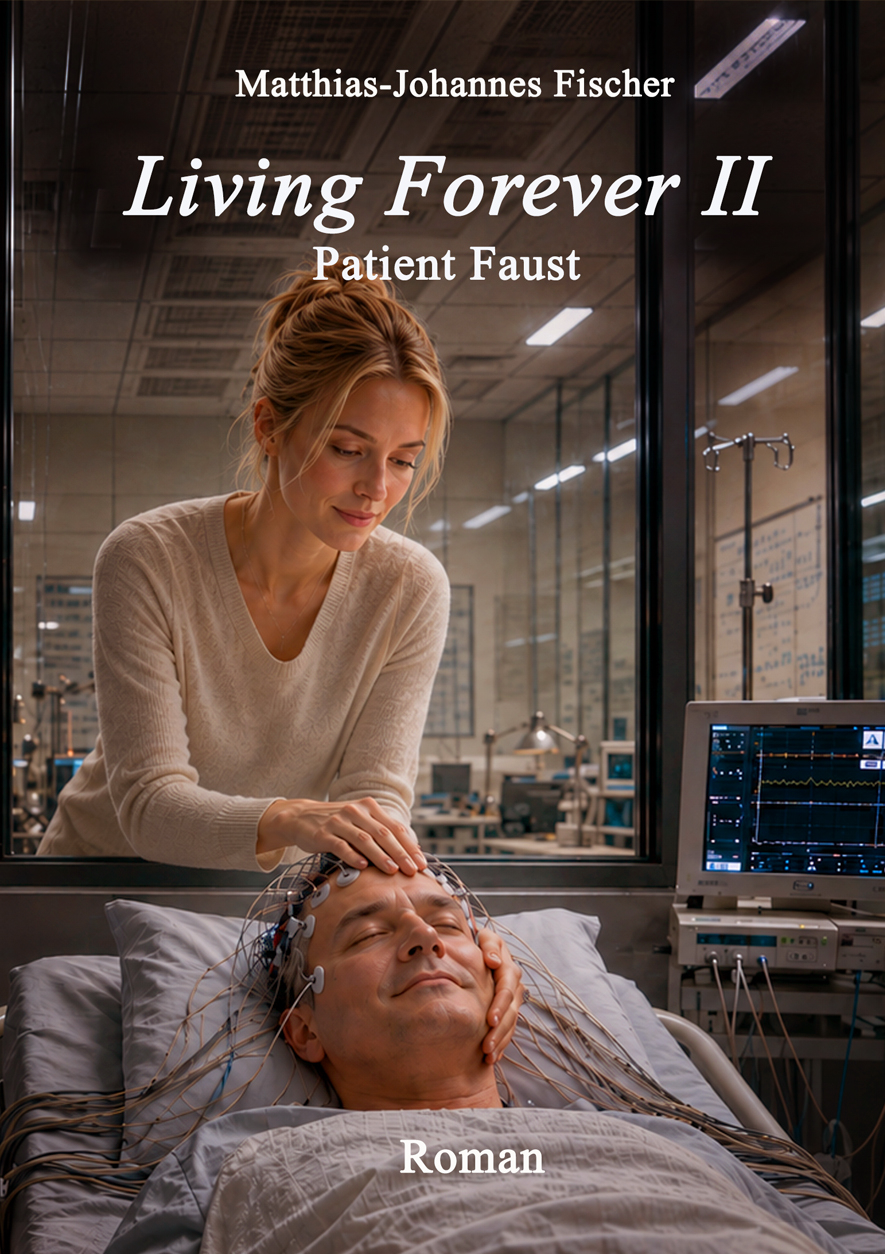
Intelligence can organise information, calculate probabilities and generate language. Consciousness, however, concerns the harder question of whether something has meaning for a being. Living Forever does not turn that distinction into a simple answer. Patient Faust can barely continue thinking without the technical connection, yet he no longer knows which thought comes from memory and which has been completed by the system.
Memory and personal identity
Memories appear to prove a life, but they are incomplete, changeable and narratively ordered. The patient assembles images into chronicles and first invents Faust as a model of himself. Are we the sum of stored experiences, our body, our relationships—or the story in which we connect them?
Digital immortality and the copy
The promise of copying consciousness suggests continuation while threatening the uniqueness of the person. A copy might share memories, voice and answers. It would still remain uncertain whether it was the same person or a new being beginning with someone else’s past.
Faust as a contemporary figure
Goethe’s Faust seeks to cross the limits of knowledge. Patient Faust faces the reverse danger: more information than a human being can turn into a meaningful life story. Faustian striving becomes a question of self-limitation. Humanity may lie not in total knowledge, but in the capacity to leave an answer open.
Key questions
- Can stored memory preserve a person?
- Is a perfect copy the same person?
- Can AI experience meaning or only process structures?
- What remains of freedom when a system completes our thoughts?
- Is mortality a defect—or a condition of human experience?